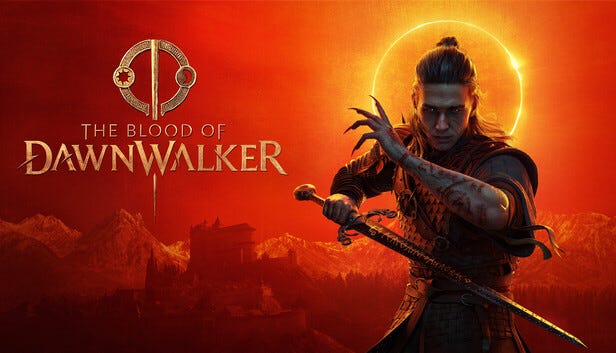
Overall, Blood of Dawnwalker left me with the impression of a short B-level RPG. If there’s nothing else to play, it’s passable, but I wouldn’t specifically recommend it to anyone. Especially if you dislike an relentlessly bleak tone, hopelessness, and shock content. Here are my main complaints.
1. Darkness for the sake of darkness
My biggest problem with the game is that it’s not just dark — it’s unnecessarily dark. It feels like the developers are constantly trying to crank the darkness slider all the way up.
Everything has to be covered in shit, dirt, blood, piss, and suffering. You’re constantly forced to examine corpses, mutilated bodiies and severed limbs
At some point, this stops working as a way to create atmosphere and starts feeling like “darkness maxing” and “drama maxing” — darkness for the sake of darkness like some edgy teenage goth story.
For me, this constant stream of misery is more likely to ruin my mood than immerse me in the world. And I can absolutely understand why some people would find this kind of tone unpleasant on a psychological level.
2. The game is too dark and visually dull
The game isn’t just narratively dark. The actual world is literally dark.
During the daytime, some areas are so dark that I had to crank the gamma almost all the way up. And even then, the image still wasn’t particularly bright.
But the problem isn’t just the lighting. The fantasy world itself feels bland and boring to me.
When I play fantasy, I expect something unusual, beautiful, and fantastical — something that makes me want to stop and simply look around. Instead, a large portion of this world consists of swamps, villages, muddy roads, and small settlements.
Instead of thinking, “Wow, what a fantastic world,” I often found myself thinking:
“Not these fucking swamps again.”
3. The scale of the world is too small
At the same time, the game tells a story that is supposedly enormous in scale: some vampire is trying to conquer the world, has blocked out the sun, and has essentially caused a global catastrophe.
But in practice, you’re running around small villages, a tiny town, and a nearby castle.
That creates a pretty funny disconnect:
There is a global threat, but its headquarters are located in some fucking rural town.
I’m not saying the game needed to show Paris, London, or huge metropolitan areas. But there’s simply too big a gap between the supposed scale of the threat and what the player actually gets to see.
4. The game is very short
Being a short game is not inherently a problem. I’d rather have 15 good hours than 100 hours of filler.
But here, the short length reinforces the feeling that the game is relatively small and not particularly content-rich. If you complete the main and side quests, the game seems to take roughly 15–20 hours.
And during that time, I never got the feeling that I had experienced some huge epic story. Quite the opposite — it feels like there simply isn’t that much content.
5. The side quests are too formulaic
This is one of my biggest complaints.
A large portion of the side quests basically boil down to:
– go to some noble’s camp and kill everyone;
– find a distillery and destroy everything;
– intercept some noble’s thugs;
– clear another location.
In other words, they’re mostly generic kill/clear quests that could almost be assembled from a template.
Basically:
marker → location → enemies → clear the area → reward.
And this is something I really didn’t expect from the developers of The Witcher.
From them, I expect interesting side stories, memorable characters, unexpected situations, choices, and consequences.
Instead, a significant portion of the side content feels like the developers simply needed to fill the map with activities.
6. The 30-day deadline is mostly an illusion
The game tells you that you have 30 days to save your family.
I took that seriously and deliberately rushed through the game. I kept thinking:
“Fuck, what if I don’t make it in time?”
But by around day 15, I had already killed all three boyars, completed a huge number of side quests, and basically dealt with almost everything I wanted to do.
So the question becomes: why was the game making me worry about time in the first place?
Half of the supposed time limit is simply left unused.
As a result, the deadline feels less like a genuine constraint and more like an illusion of urgency.
7. The time system often makes no sense
What makes it worse is that some actions consume completely arbitrary amounts of time.
For example, destroying some kind of distillery apparatus can take several time segments.
But why?
I can literally hit the thing once and destroy it. Why should that take as much time as some genuinely significant action?
Instead of making time feel like something naturally passing in the world, the system often feels like the game is simply deducting a certain number of gameplay units from you.
The system exists, but it isn’t always clear why it exists in this particular form.
8. You can’t properly disengage from combat
This is one of the most frustrating mechanical problems.
You see a boar or a bear and think:
“I don’t want to fight this thing. I just want to keep going.”
But the game doesn’t really let you leave combat properly.
Cohen often can’t jump over simple obstacles, can’t step over tiny rocks, and generally behaves as if he’s surrounded by invisible walls.
And this is despite the fact that he has supernatural abilities that should, in theory, give him plenty of ways to control distance.
9. The teleportation doesn’t work the way the player wants
You press RT because you want to get away from the enemies, and the game teleports Cohen behind an enemy instead.
But I don’t want to teleport toward the enemy.
I want to teleport away from the enemy.
Especially when some fucking boar is chasing you around and simply wasting your time.
A movement ability that should help the player control positioning can actually get in the way instead.
10. Transformations don’t let you escape properly either
There’s the wolf transformation and various other supernatural abilities, but when you actually need to leave combat, the game doesn’t always let you do it properly.
So you end up with this strange situation where the character has all kinds of supernatural powers, but simply running away from a fight becomes a problem.
It really hurts the feeling of player control.
11. The combat automatically picks the wrong target
Another annoying issue is the automatic target selection.
For example, you use a dirty trick and blind a specific enemy because you want to take him out quickly.
Makes sense.
But then the game suddenly switches to another enemy and can even make your character dash across half the room just to attack someone else.
So you’ve just created a tactical advantage against a specific enemy, and the game decides:
“No, you’re going to attack this guy instead.”
It makes the combat feel like the player doesn’t actually have full control over what’s happening.
12. The dialogue often tells you what you’re supposed to think
I also didn’t like the constant lecturing — the feeling that the game isn’t just telling a story, but is repeatedly explaining the correct moral position to you.
Also, I didn’t like how the game handles the lecturing about the Jews. It reminded me of Kingdom Come: Deliverance, which also occasionally gave me that same feeling.
My problem isn’t with the historical subject itself. It’s with how the subject is presented.
13. The feeling of modern ideological messaging
Some of the characters also felt like very obvious vehicles for contemporary ideological messaging.
For example, there’s the comment from Oha about men worrying about their size and going bald. To me, that just came across as a sexist joke at the expense of men.
And it made me think about the double standard: if a female character were mocked in an equivalent way for some physical characteristic, I suspect the line would be received very differently.
I don’t like that kind of asymmetry.
14. The RPG doesn’t really let you role-play
This is where I have a more fundamental problem.
The game is supposedly an RPG and gives you dialogue choices, but when an opportunity comes up to take a position that contradicts a particular modern ideology, that option often simply isn’t there.
For example, characters can make snide remarks about feminism, gender roles, and so on. And you’re sitting there thinking:
“Actually, I have a problem with that. I want to say so.”
But there’s no corresponding dialogue option.
The game has already decided that your character is supposed to agree.
So where exactly is the role-playing?
If I can’t establish my character’s own position and can’t disagree with another character when I want to, then it’s not really “I’m role-playing this character.” It’s more like “I’m choosing one of the responses the writers have approved.”
15. Characters and diversity
I also felt that some characters were included with a fairly obvious goal of representing certain forms of contemporary diversity.
For example, Marat, as well as the African character.
The mere presence of such characters is not automatically a problem for me. The problem is when a character starts to feel primarily like a representative of a particular social category, rather than an interesting character who naturally exists within the world.
16. Technical problems and stuttering
The game also doesn’t run perfectly.
I noticed quite a lot of stuttering, which is particularly annoying when the game itself isn’t exactly blowing me away with its visual design.
So you end up with a world that isn’t especially interesting to look at, combined with occasional problems with smoothness and performance.
17. Overall feeling: a B-level game
And all of this combined gives me the feeling of a small B-level RPG.
And by B-level, I don’t mean “bad graphics.”
With modern Unreal Engine 5, getting technically attractive visuals isn’t nearly as difficult anymore. The engine itself handles a huge amount of the work involving lighting, materials, and visual effects.
To me, B-level here means:
– small scale;
– short length;
– formulaic side quests;
– limited variety in activities;
– strange movement restrictions;
– a questionable time system;
– frustrating combat controls;
– stuttering;
– a bland and repetitive world;
– and the feeling that the supposed scale and seriousness of the story don’t match what actually happens in the game.
Conclusion
Overall, Blood of Dawnwalker is a “better than nothing” kind of game for me.
It’s not so terrible that I couldn’t play it. But I also didn’t find enough good things about it to say “you absolutely have to try this.”
In particular, I wouldn’t recommend it to people who dislike constant bleakness, gore, corpses, suffering, and hopelessness. Those aren’t occasional elements here — they’re practically the background of the entire game.
And most importantly, I expected much more from the developers of The Witcher. I expected deeper side stories, a more interesting world, more coherent gameplay systems, and more freedom in role-playing the protagonist.
Instead, I got a relatively short, relentlessly bleak, occasionally technically rough RPG where a significant portion of the side content boils down to clearing yet another location on the map.
It’s playable. But I wouldn’t recommend it.